---
title: "Your Team Is Already Using AI. The Question Is: Do You Have a Policy?"
description: Your team is already using AI, but do you have a policy? Discover how SMBs can build practical governance guardrails to protect data and innovate.
image: https://www.yourpeas.com/hubfs/AI-Generated%20Media/Images/Modern%20Office%20Meeting%20with%20AI%20Governance%20Presentation.png
---
[](https://www.yourpeas.com/)
[](https://www.yourpeas.com/)
- [About](https://www.yourpeas.com/about)
- [Executive Growth Portal](https://www.yourpeas.com/executive-growth-portal)
- Services
- [Fractional Executive Assistance](https://www.yourpeas.com/executive-assistant-services)
- [Fractional Business Development](https://www.yourpeas.com/fractional-business-development)
- [Fractional Chief of Staff](https://www.yourpeas.com/chief-of-staff)
- [Resources](https://www.yourpeas.com/peas-insights)
[Contact Us](https://www.yourpeas.com/contact)
May 26, 2026, 6:25:34 AM
# Your Team Is Already Using AI. The Question Is: Do You Have a Policy?
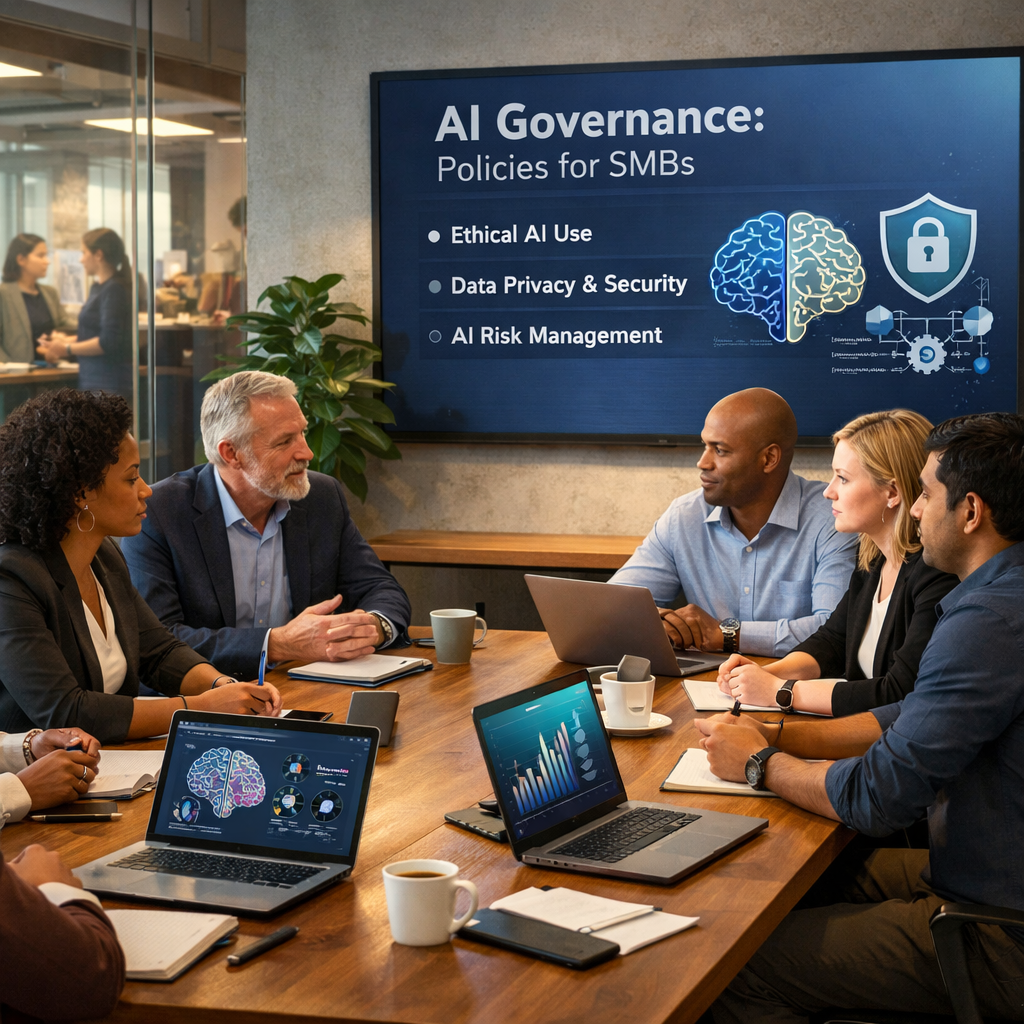
Artificial Intelligence is no longer something businesses are “considering for the future.” It is already embedded in the day-to-day operations of companies of every size. Your employees are using it, your contractors are using it and your partners are likely using it too. The real question for SMB leaders is this:
Do you know how it’s being used inside your business?
For many business owners and executives, the honest answer is “not really” and that’s understandable. Most small and mid-sized businesses have been moving so quickly trying to keep up with growth, staffing challenges, client demands, and operational pressures that AI governance simply hasn’t made it onto the priority list yet. But ignoring it does not reduce the risk.
**The Risk Usually Isn’t Malicious**
When people hear “AI risk,” they often think about hackers, data breaches, or employees intentionally doing something wrong. In reality, the biggest risk for most SMBs is usually accidental. These could be anything from; An employee copying confidential client information into a public AI tool to help write an email. A contractor uploads internal documentation into an AI platform to summarize meeting notes. A sales representative uses AI-generated messaging that unintentionally creates compliance concerns. A channel partner uses unauthorized tools that expose sensitive operational information.
None of these situations are typically malicious.
They happen because there are no clear guidelines, no approved-use policies, and no framework for responsible AI usage inside the business.
**AI Adoption Is Moving Faster Than Governance**
Recent independent research shows just how quickly this gap is growing. According to 2025 research from ISACA, 83% of business and IT professionals believe employees are already using AI tools at work. Yet only 31% of organizations have implemented a formal, comprehensive AI policy. Even more telling, ISACA’s 2026 AI Pulse Poll found that while AI usage continues to accelerate across organizations, governance and operational readiness are still lagging behind. Only 38% of organizations surveyed reported having a formal AI policy in place.
At the same time, a 2025 survey from TELUS Digital revealed that:
• 57% of employees using generative AI at work admitted entering sensitive or high-risk information into public AI assistants
• 68% were accessing AI tools through personal accounts rather than approved corporate systems
This growing trend is often referred to as “Shadow AI”, where employees adopt AI tools independently without visibility, governance, or oversight from leadership. For SMBs especially, this creates operational, reputational, compliance, and client confidentiality risks that many organizations simply have not considered yet.
**Governance Does Not Mean Slowing Innovation**
This is where many organizations get stuck. They assume implementing AI policies means introducing bureaucracy or limiting innovation. In reality, effective governance does the opposite. It creates clarity as it gives employees confidence around what is acceptable and what is not. It also protects company information, client relationships, and operational integrity while still allowing teams to benefit from modern AI tools responsibly.
The goal is not to prevent AI usage. The goal is to create practical guardrails around it.
**A Practical Approach for SMBs**
At Professional Executive Associates (PEAS), we believe SMBs need practical operational frameworks, not overly complicated enterprise processes that are impossible to implement.
That is why we have partnered with FractionX to help organizations:
• assess how AI is currently being used internally
• identify potential operational and compliance risks
• establish clear AI usage guidelines
• create practical company AI policies
• support employee, contractor, and partner accountability
The process is designed to be approachable, actionable, and aligned to the realities of SMB operations. Because whether businesses are ready or not, AI is already part of the workplace. The organizations that will benefit most are not necessarily the ones moving the fastest, they are the ones putting the right structure around it early.
**Final Thoughts**
In many ways, AI governance is becoming similar to cybersecurity policies several years ago. At one point, many businesses assumed “We’re too small to worry about that”. Today, cybersecurity policies are considered a standard operational requirement, and AI governance is quickly heading in the same direction. The businesses that address it proactively will not only reduce risk — they will create stronger operational clarity, accountability, and trust across their teams and partner ecosystems, and in today’s business environment, that matters more than ever. If your organization has not yet discussed how AI tools are being used internally, now is the time to start the conversation.
At Professional Executive Associates (PEAS), in partnership with FractionX, we help SMB leaders take a practical and responsible approach to AI governance.
From assessing current AI usage to developing clear, workable policies for employees, contractors, and partners, our goal is simple: to help organizations embrace AI confidently while reducing unnecessary operational and compliance risk.
If you would like to learn more about creating an AI governance framework for your business, we would welcome a conversation.
*Research Sources:
• https://www.isaca.org/about-us/newsroom/press-releases/2025/ai-use-is-outpacing-policy-and-governance-isaca-finds
• https://www.isaca.org/about-us/newsroom/press-releases/2026/ai-use-accelerates-while-governance-and-roi-lag-says-new-isaca-research
• https://www.telusdigital.com/about/newsroom/telus-digital-survey-reveals-enterprise-employees-use-of-shadow-ai*
May 26, 2026, 6:25:34 AM
[AI](https://www.yourpeas.com/peas-insights/tag/ai) [B2B](https://www.yourpeas.com/peas-insights/tag/b2b) [Operations](https://www.yourpeas.com/peas-insights/tag/operations)
## Blog
[](https://www.yourpeas.com/)
   
General
- [About](https://yourpeas.com/about/)
- [Insights](https://www.yourpeas.com/peas-insights)
Others
- [P.E.A.S Partners](https://yourpeas.com/peas-pod/)
- [Contact](https://yourpeas.com/contact/)
Legal
- [Privacy Policy](https://www.yourpeas.com/privacy-policy-peas)
[Facebook](https://www.facebook.com/YourPEAS)
[LinkedIn](https://www.linkedin.com/company/p-e-a-s-your-professional-executive-associates-inc/)
```json
{
"@context" : "https://schema.org",
"@type" : "BlogPosting",
"author" : {
"@type" : "Person",
"name" : "PEAS",
"url" : "https://www.yourpeas.com/peas-insights/author/peas"
},
"dateModified" : "2026-05-26T11:31:29.478Z",
"datePublished" : "2026-05-26T10:25:34.000Z",
"headline" : "Your Team Is Already Using AI. The Question Is: Do You Have a Policy?",
"image" : [ "https://www.yourpeas.com/hubfs/AI-Generated%20Media/Images/Modern%20Office%20Meeting%20with%20AI%20Governance%20Presentation.png" ],
"mainEntityOfPage" : {
"@id" : "https://www.yourpeas.com/peas-insights/your-team-is-already-using-ai.-the-question-is-do-you-have-a-policy",
"@type" : "WebPage"
},
"publisher" : {
"@type" : "Organization",
"logo" : {
"@type" : "ImageObject",
"url" : "https://www.yourpeas.com/hubfs/PEAS-logo.png"
}
}
}
```